
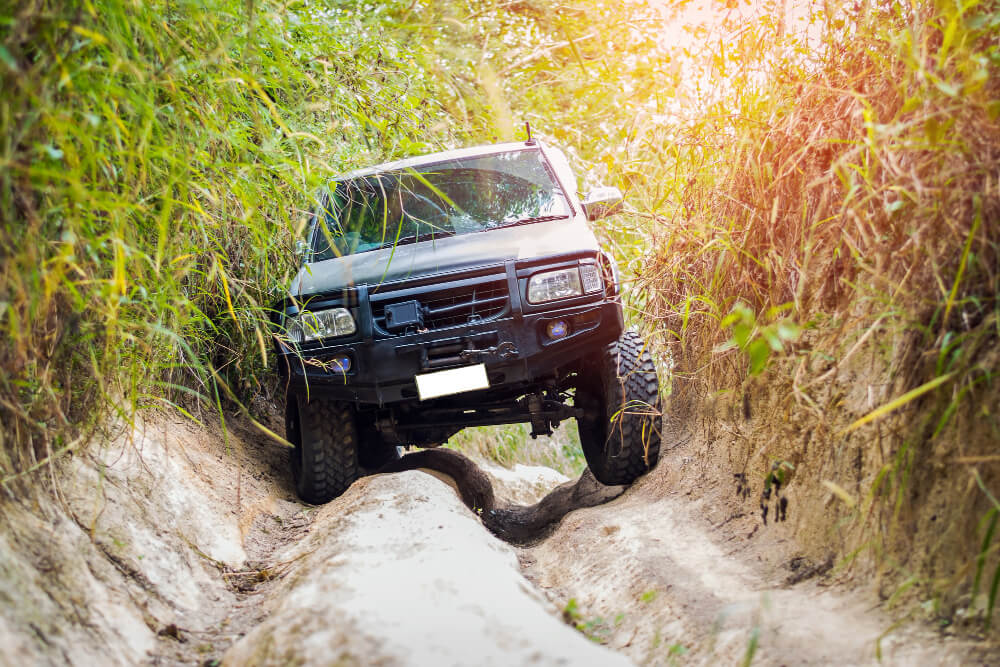
Four-wheel drive gives drivers a real sense of confidence, and honestly, that confidence is earned to a point. A 4WD or AWD vehicle genuinely performs better in challenging conditions than a two-wheel drive vehicle. The problem is that confidence can grow faster than actual capability, and that gap is exactly where most off-road recovery situations are born.
So, can 4WD get stuck? Yes, it absolutely can. And it happens more often than most drivers expect, even to experienced off-roaders. This article breaks down what four-wheel drive actually does, the specific conditions where it falls short, why overconfidence plays such a large role, and what to do when self-recovery is no longer a realistic option. If you are ever in a genuine off-road recovery situation in the Cleveland area or surrounding Northeast Ohio communities, Speedy Fleet Towing Service is available 24 hours a day at 1 (216) 810-8086 and we handle off-road recovery throughout the region.
What 4WD and AWD Actually Do
Before getting into limitations, it helps to understand what these systems are designed to do in the first place.
Four-wheel drive and all-wheel drive systems work by sending engine power to all four wheels rather than just two. In a standard two-wheel drive vehicle, only the front or rear wheels receive power, so if those wheels lose traction, the vehicle stops moving. By powering all four wheels, 4WD and AWD systems dramatically improve a vehicle’s ability to maintain momentum on slippery, uneven, or loose terrain.
That is genuinely useful. But here is the important distinction that does not get talked about enough:
4WD helps a vehicle move through difficult terrain. It does not prevent a vehicle from sinking into it.
Traction and floatation are two completely different things. Four-wheel drive addresses traction. It does nothing to reduce the weight pressing down on soft ground, and it does not increase tire surface area unless you make deliberate adjustments. That distinction matters enormously once you are out on the trail.
The Off-Road Conditions Where Even 4WD Vehicles Can Get Stuck
Deep Mud
Mud is one of the most common causes of off-road recoveries, and 4WD does not change how mud behaves. Deep mud creates suction around the tires and undercarriage, and the harder a vehicle works to escape, the deeper it can sink. Larger trucks and SUVs with 4WD actually face a disadvantage here because their added weight works against them in soft, saturated ground.
Soft or Waterlogged Terrain
In Northeast Ohio, the spring thaw between March and May is one of the most deceptive seasons for off-road driving. Ground that looks and even feels firm on the surface can be completely saturated just a few inches down. Fields, stream banks, and rural trail edges are particularly prone to this. A 4WD truck can break through that surface crust and drop several inches before the driver even realizes what is happening.
Deep or Untracked Snow Over Soft Ground
Snow adds another layer of complexity because it hides what is underneath. Deep, untracked snow over soft or uneven terrain is one of the most common recovery scenarios during Ohio winters. 4WD helps the vehicle push through packed snow, but when the snow is deep enough to high-center the vehicle or the ground beneath is soft, traction becomes irrelevant.
Steep and Off-Camber Terrain
Ground clearance and wheel articulation matter just as much as drive system when terrain gets steep or uneven. A vehicle can lose contact between a tire and the ground on severe off-camber slopes, and when a wheel is in the air, sending power to it does nothing useful.
Why Drivers Tend to Overestimate Their 4WD Vehicle
This is worth talking about honestly because it is a pattern that plays out constantly, and it has nothing to do with how smart or experienced a driver is.
Vehicle marketing has consistently sold 4WD and AWD capability through imagery of extreme terrain. Trucks crawling over boulders, SUVs pushing through rivers, that kind of thing. That creates an impression that does not always match day-to-day off-road reality. When you add in the tactile feeling of 4WD engaging, the vehicle genuinely feels more capable, and that feeling is not wrong exactly, it is just incomplete.
Most drivers also do not clearly distinguish between three separate concepts: traction, floatation, and ground clearance. They each address a different problem off-road, and having one does not substitute for another. Treating them as the same thing is how capable vehicles end up in situations they were not built for.
Early positive experiences off-road compound the issue. A few successful trips through mud or snow builds real confidence, but it can also push drivers toward terrain that exceeds what their vehicle and experience level can actually handle safely.
How Continuing to Push Through Makes the Situation Worse
Here is a critical point that applies whether you are in deep mud, soft ground, or heavy snow: the moment you realize the vehicle is not moving forward, how you respond in the next 60 seconds matters a lot.
Continuing to spin the wheels digs the vehicle progressively deeper. Each attempt at acceleration removes more material from under the tires and settles the vehicle lower. What started as a recovery that might have been solved with a traction mat can quickly become a situation requiring a winch and rigging.
Beyond getting stuck deeper, there are mechanical consequences to consider.
- Sustained wheel spinning in a stuck vehicle can overheat the transfer case and transmission, particularly in AWD systems not designed for continuous high-load off-road use
- Aggressive rocking on uneven terrain shifts the vehicle’s weight distribution and can make safe extraction more complicated
- Undercarriage components, including the differential, skid plates, and drive shafts, can sustain damage when a vehicle is pushed hard in a deeply stuck position
Two calm, measured attempts at self-recovery are reasonable. Beyond that, stopping and assessing the situation is almost always the smarter call.
Practical Steps to Reduce Your Chances of Getting Stuck
Good off-road driving is largely about preparation and knowing your limits before you reach them. A few habits make a meaningful difference.
- Research the terrain before you drive it. Trail conditions, recent rainfall, and seasonal ground saturation are all worth checking ahead of time. If you have not been on a route before, go with someone who has.
- Air down your tires before hitting soft terrain. Reducing tire pressure from the standard road PSI to somewhere in the range of 15 to 20 PSI increases the tire’s contact patch significantly and is one of the most effective techniques for improving floatation in mud, sand, and soft ground.
- Carry basic recovery gear. A set of traction mats, a recovery strap rated for your vehicle’s weight, and at least one shackle cover the majority of lighter stuck situations without needing outside help. They take up minimal space in a truck bed or cargo area.
- Know your specific system. Part-time 4WD, full-time 4WD, and AWD each work differently and have different engagement rules and limitations. Understanding which system you have and how to use it correctly affects both performance and the risk of drivetrain damage.
- Trust your instincts on difficult terrain. Momentum is valuable off-road, but committing to a line that exceeds your vehicle’s capability is how manageable situations become serious ones. There is no shame in backing off and finding a better route.
When to Call for Professional Off-Road Recovery
A standard tow truck is designed to service vehicles on or immediately adjacent to a paved road. It is not equipped to safely recover a vehicle that is buried past the axles, positioned on an incline, or located in terrain that is not road-accessible. Using the wrong equipment or attaching a recovery line to the wrong point on a vehicle can cause frame damage, bent suspension components, or drivetrain failure that costs significantly more to repair than a proper recovery would have.
Signs that professional off-road recovery is the right call:
- The vehicle has sunk past the axles in mud, soft ground, or snow
- The vehicle is on a slope or embankment where pulling angle matters
- The terrain surrounding the vehicle is not accessible to standard tow equipment
- Multiple self-recovery attempts have already made the situation noticeably worse
Speedy Fleet Towing Service provides 24-hour off-road recovery for drivers in Cleveland and throughout the surrounding Northeast Ohio communities. You can reach us any time at 1 (216) 810-8086.
The Short Answer to Can 4WD Get Stuck
Yes. Four-wheel drive improves traction and helps vehicles move through difficult terrain, but it does not prevent a vehicle from sinking into soft ground, getting high-centered, or losing contact on steep terrain. The best off-road drivers are not necessarily the ones with the most capable trucks. They are the ones who understand their vehicle’s limits, prepare before heading out, and recognize when the right move is to stop and call for the right kind of help.
If you are in a stuck situation in the Cleveland area or the surrounding Northeast Ohio communities, Speedy Fleet Towing Service is available 24 hours a day at 1 (216) 810-8086. We are here to help you get out safely, without making the situation harder or more expensive than it needs to be.


