
Most drivers never think twice about which tow truck shows up after a breakdown. You call for help, a truck arrives, and you trust that everything will be handled correctly. That assumption is completely understandable, but it can sometimes lead to vehicle damage that does not show up until days after the tow. The type of tow truck used on your vehicle genuinely matters, and knowing why can save you from a frustrating and expensive surprise down the road.
This article breaks down the main tow truck types, explains how your vehicle’s drivetrain affects which method is safe to use, and gives you practical steps to take the next time you need to make that call. If you are in Cleveland and need wheel lift towing, Speedy Fleet Towing Service is ready to help — give us a call at 1 (216) 810-8086.
The Three Main Types of Tow Trucks
Not all tow trucks work the same way. Each type is built for specific situations, and understanding the basics helps you ask the right questions when you need a tow.
Flatbed Tow Truck
A flatbed tow truck loads your entire vehicle onto a flat platform, lifting all four wheels completely off the ground. This method is widely considered the safest option for most vehicles because there is no contact between your tires and the road during transport. It is especially recommended for all-wheel drive and four-wheel drive vehicles, luxury cars, and vehicles with low ground clearance.
Wheel Lift Tow Truck
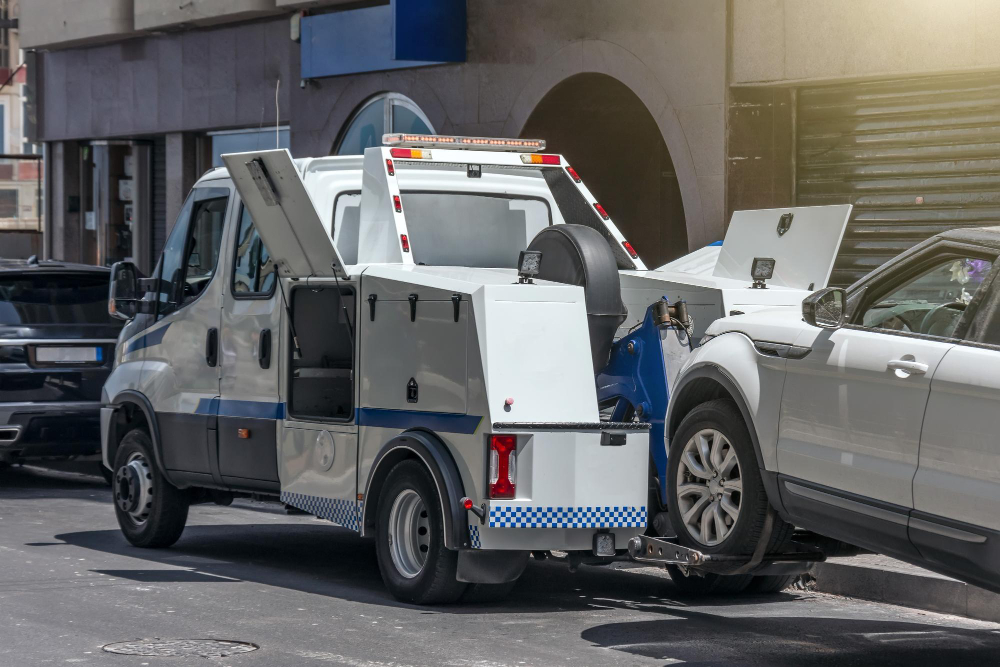
A wheel lift tow truck uses a metal yoke to raise either the front or rear wheels off the ground while the other two wheels roll along the road. It is faster to deploy than a flatbed and works well for many standard towing situations, but only when the correct set of wheels is lifted based on how your specific vehicle is built. That detail matters more than most people realize.
Hook and Chain
This method involves wrapping chains around the vehicle’s frame or axle. Hook and chain towing is largely outdated and rarely used today because of the risk of frame and body damage. If you encounter a towing company still using this as their primary method, it is worth asking questions before agreeing to it.
Why Tow Truck Type Matters for Your Drivetrain
Your vehicle’s drivetrain determines which wheels power the car, and that directly affects which towing setup is safe to use. Getting this wrong is the most common cause of towing-related vehicle damage, and it happens more often than people expect.
Front-Wheel Drive (FWD)
In a front-wheel drive vehicle, the front wheels handle both power and steering. Wheel lift towing with the front wheels raised and rear wheels rolling is generally safe. However, if the rear wheels are lifted instead and the front wheels are left dragging on the ground, you risk transmission damage because the drive wheels are under stress while rolling freely.
Rear-Wheel Drive (RWD)
For rear-wheel drive vehicles, the logic flips. The rear wheels are the drive wheels, so lifting the rear and letting the front wheels roll is the safer wheel lift configuration.
All-Wheel Drive (AWD) and Four-Wheel Drive (4WD)
AWD and 4WD systems are designed so that all four wheels work together. When only two wheels are on the ground and rolling during a tow, it forces the drivetrain to operate in a way it was never intended to. This puts serious stress on the transfer case, differentials, and driveshaft. For these vehicles, a flatbed is almost always the right choice, not just a preference.
Real Damage That Can Happen From the Wrong Tow
Improper towing does not always cause obvious, immediate damage. That is part of what makes it so frustrating. A driver can pick up their vehicle, drive it home, and feel like everything is fine, only to notice something is off a week later. By that point, connecting the problem back to the tow becomes much harder.
Here are the damage types most commonly associated with incorrect towing methods:
- Transmission damage: Dragging drive wheels while the transmission is engaged is one of the most frequent and costly outcomes of using the wrong towing setup.
- Differential damage: AWD and 4WD vehicles are especially vulnerable when the front and rear axles are forced to rotate at mismatched speeds during transport.
- Driveshaft stress: Sustained strain on the driveshaft during an improper tow can lead to accelerated wear or eventual failure.
- Undercarriage scraping: Low-clearance vehicles can sustain scraping or structural damage if not loaded onto the appropriate truck with proper care.
These are not rare worst-case outcomes. They are real, documented results that towing professionals see when the wrong method is used on the wrong vehicle.
What to Tell the Towing Company When You Call
- Know your drivetrain type. Check your owner’s manual or do a quick search using your vehicle’s make and model. Whether it is front-wheel drive, rear-wheel drive, AWD, or 4WD, that single piece of information is the most useful thing you can share.
- Give your vehicle’s make, model, and year. This helps the dispatcher choose the right truck before it even leaves the lot.
- Ask whether the truck being sent is appropriate for your drivetrain. A reputable towing company should already be asking this, but confirming it yourself is always reasonable.
- If you drive an AWD or 4WD vehicle and there is any uncertainty, request a flatbed specifically. This is a standard, professional request and any quality towing company will accommodate it without hesitation.
A good towing company will ask most of these questions on their own. If they do not, now you know exactly what to bring up.
The Bottom Line
So, does tow truck type matter? It genuinely does, and the answer comes down to how your specific vehicle is built. The right towing method for a front-wheel drive sedan is not the same as what an AWD crossover needs. Knowing the difference, even at a basic level, gives you a real advantage when something goes wrong on the road.
If you ever find yourself stranded in the Cleveland area, Speedy Fleet Towing Service is here to help. Give us a call at 1 (216) 810-8086 and we will make sure the right truck is dispatched for your vehicle. The best time to save our number is long before you ever need it.


