
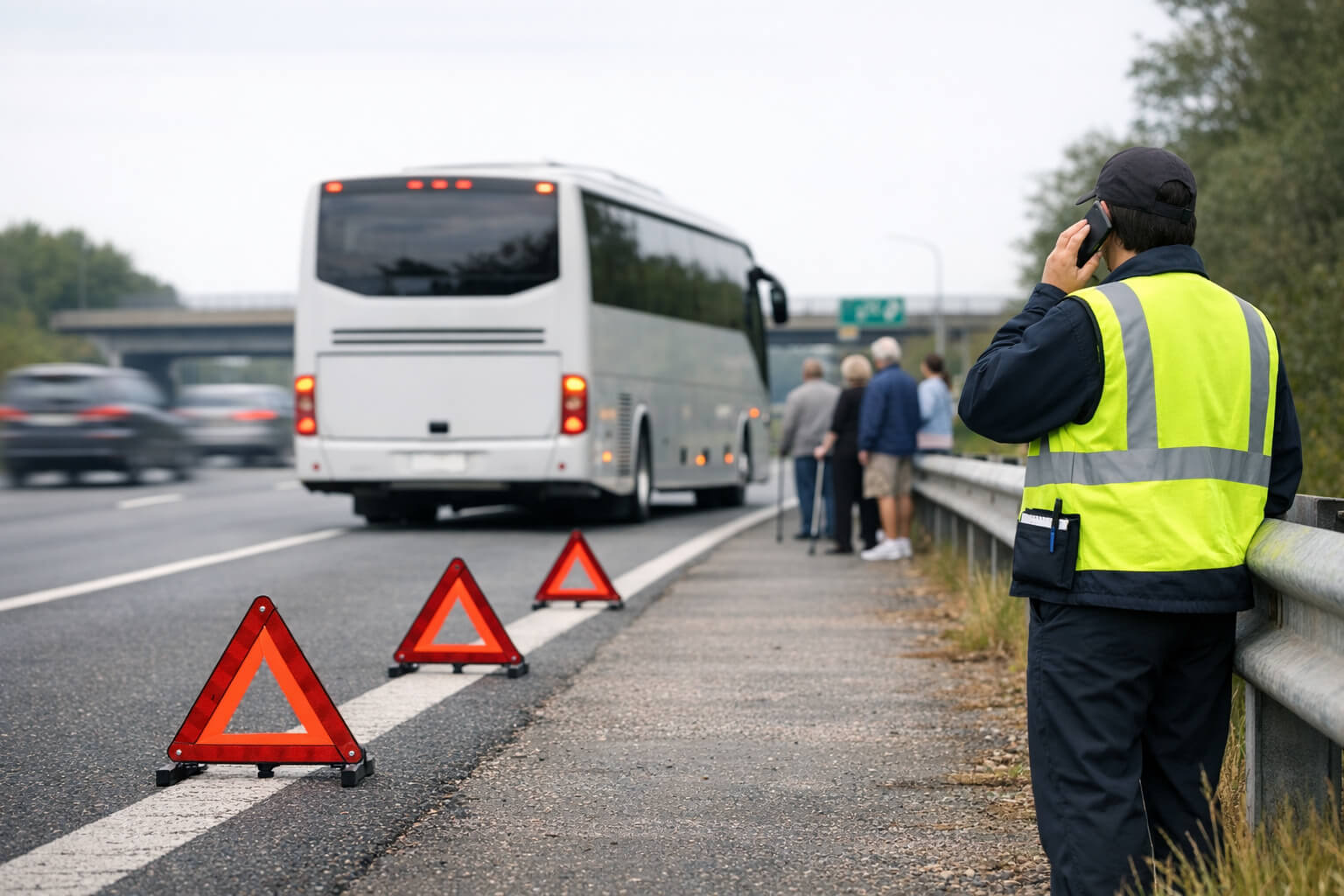
When a bus breaks down, the safest outcome depends on a few quick decisions: get the vehicle as far out of traffic as you safely can, make the scene visible, keep passengers controlled and away from moving vehicles, and communicate clearly with dispatch so the right help arrives fast. If you’re in Cleveland or the surrounding area and you need heavy-duty assistance for a disabled bus, Speedy Fleet Towing Service Cleveland can be reached at 1 (216) 810-8086 while you work through the steps below.
Immediate priorities: protect people and prevent a secondary incident
Turn on hazard lights immediately. If visibility is reduced by rain, fog, or dusk, use headlights as well. If you’re stopped in or near a travel lane, keep the bus steady and predictable: avoid rolling backward, don’t open doors into traffic, and keep passengers seated until you’ve assessed what’s safest.
Look for urgent hazards that change what you do next, such as smoke, a fuel smell, sparks, an engine compartment fire risk, or a bus that has come to rest in a dangerously exposed position (blind curve, hill crest, narrow shoulder). If anything suggests fire or imminent danger, your plan shifts toward evacuation and calling emergency services.
Decide quickly: can you safely move the bus out of traffic?
If the bus can still steer and brake normally, moving it fully out of the travel lane is often the single biggest safety improvement you can make. A few seconds of controlled movement to a safer location can prevent a serious secondary collision.
Move the bus only if these conditions are true:
- Steering responds normally and the bus tracks straight
- Brakes feel normal and you can stop smoothly
- You are not hearing or feeling severe mechanical grinding, wheel lockup, or drivetrain binding
- You have enough momentum to clear the lane without stalling again in a worse spot
If the bus is losing air pressure rapidly, the steering or brakes feel compromised, or a wheel/tire problem is obvious, staying put may be safer than attempting a move that could cause loss of control.
Use visibility measures right away (hazards, lights, triangles or flares if safe)
Hazard flashers are not always enough on a high-speed roadway, especially in poor weather or when traffic is distracted. Reflective warning triangles are often the best next step when it’s safe to deploy them. If placing triangles requires you to walk in or near a live lane, don’t do it. Your safety comes first.
If you do place triangles, do it deliberately and only when you have a safe path behind a barrier or on a wide shoulder. Keep your body oriented toward traffic so you can see what’s coming, and return to the safest waiting position as soon as possible.
Positioning the bus safely (and when not to move it)
Where the bus ends up matters as much as whether it moves at all. A bus that is “kind of” on the shoulder can still be clipped by passing traffic. Aim for a stop that removes the bus from the flow of vehicles, not just a stop that feels less stressful.
If the bus is drivable: the safest place to stop
Choose the first genuinely safe location you can reach without pushing the bus beyond its limits:
- A wide shoulder or breakdown lane where the bus can be fully out of the travel lane
- A designated pull-off, rest area, or maintenance turnout
- A nearby parking lot or side street, if accessible without risky maneuvers
As you position the bus, consider door-side exposure. If you stop on the right shoulder, doors on the right side can be safer for passenger control, but only if there’s enough space and passengers can stand well away from traffic.
If the bus is not drivable: safest “stay put” positioning and passenger control
If you cannot move the bus, your safest choice is often to keep everyone on board with seatbelts fastened where available, doors closed, and passengers calm while you coordinate help, unless there’s a fire risk, smoke, or another immediate hazard. A bus cabin can act as a protective shell compared to standing on a narrow shoulder.
Set clear boundaries: no one exits unless you instruct it, no one stands in stairwells, and no one congregates near the roadway-side windows or door areas.
Special situations: bridges, curves, narrow shoulders, and construction zones
Some breakdown locations are unsafe no matter what you do.
- On a bridge or narrow shoulder: passengers outside the bus may have nowhere safe to stand. Keeping people on board is often safer unless there’s a fire risk.
- On a blind curve or hill crest: visibility is poor for approaching drivers. Increase visibility, call for help immediately, and be ready for law enforcement to manage traffic if needed.
- In construction zones: lane shifts and barriers reduce escape options. Avoid moving cones or entering closed areas. Communicate your exact position and direction of travel to dispatch.
Passenger safety and communication
Passenger behavior is a major safety variable. People will look to you for cues, and vague instructions create movement, confusion, and risk.
Make a short, calm announcement that tells passengers what to do right now and what to expect next. A good message includes:
- The bus is stopped due to a mechanical issue
- Everyone should remain seated (or remain where they are) unless instructed
- You are contacting dispatch and help is on the way
- A reminder to keep aisles clear
If you have a second staff member (a monitor, attendant, or another driver), use them to keep eyes on the passenger area while you communicate with dispatch.
When to evacuate vs. keep passengers on board
Evacuation sounds proactive, but it can be more dangerous than staying inside when traffic is close. Moving people onto a shoulder puts them near fast vehicles, uneven ground, and poor visibility.
Evacuate when staying on the bus is clearly more dangerous, such as:
- Smoke in the cabin or engine compartment
- Fire risk, visible flames, or strong fuel smell
- The bus is in a position likely to be struck (for example, blocking a live lane with limited sight distance) and there is a safe area to move people
If you evacuate, do it with a destination in mind: behind a guardrail, up an embankment away from traffic, or into a protected area like a building or fenced lot if nearby.
Safe evacuation procedure (if required): where to move people and how to regroup
If you must unload, focus on control and accountability:
- Choose the exit route that keeps passengers away from traffic (usually the shoulder side)
- Move the group together to a safe spot behind a barrier or far off the roadway
- Do a headcount and keep passengers in one contained area
- Assign adults to help supervise children or vulnerable passengers
- Keep people away from the bus and away from the space between the bus and traffic
Avoid having passengers wait near the bus “because it feels familiar.” The safest waiting spot is the one farthest from moving vehicles.
Accessibility considerations: mobility devices, medical needs, children, and seniors
Plan extra time and extra hands for passengers who need assistance. Wheelchairs, walkers, and medical equipment make hurried movements risky. If the bus is not immediately dangerous, keeping these passengers aboard while you coordinate an accessible transfer is often safer than attempting a rushed roadside exit.
If evacuation is necessary, prioritize a stable, level area where mobility devices can be managed without tipping or rolling toward traffic.
Secure the scene and manage traffic risk
Most serious roadside injuries happen after the breakdown, not during it. Your goal is to make the situation boring and predictable for passing drivers.
Keep passengers away from the roadway edge and never allow anyone to stand in the “fatal zone” between the bus and passing vehicles. If the shoulder is narrow, keep people inside. If there is a guardrail, use it. If there is no barrier, create distance by moving to the far side of a ditch or embankment only if it’s safe and stable.
Limit door openings. Every time doors open, someone is tempted to step out, and approaching traffic can change quickly. If you must open the door, position yourself to control the flow and close it again once the immediate need is met.
Night, rain, and fog raise the risk sharply. Even with hazards on, drivers may not recognize a stopped vehicle until the last moment. In low visibility, avoid having passengers outside unless it’s clearly safer than remaining onboard.
Troubleshoot only what’s safe (and what to avoid)
You can gather useful information without putting yourself in danger. You don’t need to diagnose the bus on the shoulder, you need to describe what’s happening accurately so dispatch and responders can make good decisions.
Low-risk checks include:
- Dashboard warning lights and messages
- Unusual smells (hot brakes, burning oil, electrical odor)
- Signs of overheating (temperature gauge, steam)
- Obvious tire issues you can see from a safe position
Avoid crawling under the bus, reaching into wheel wells near traffic, or opening compartments that put you in an exposed position on the traffic side. Leave hands-on inspection for a safer environment.
If overheating is suspected, shut the engine down and let it cool. Never open a hot cooling system cap. A pressurized system can release scalding coolant and steam.
What to tell dispatch or roadside assistance (to get the right help fast)
Good information shortens the time to the right solution. The goal is to give a clear picture of location, bus type, passenger situation, and what the bus can or cannot do.
Share location in multiple ways:
- Road name and direction of travel
- Nearest exit or cross street
- Mile marker if available
- A visible landmark (large sign, bridge name, nearby business)
Then add bus and situation details that affect response:
- Bus length or type (transit bus, coach, shuttle)
- Approximate passenger count and whether anyone needs medical assistance
- Whether the bus is in a lane, fully on the shoulder, or in a lot
- Whether the bus can move under its own power
- Any hazards: smoke, fluid leaking, strong odor, low visibility, blocked lanes
If it appears you’ll need heavy-duty towing or recovery, mention any constraints: low bridge clearance nearby, tight shoulder, construction barriers, or a bus positioned at an angle that will complicate loading.
Preparing for towing or recovery without delaying help
While waiting, you can reduce downtime by preparing basics that don’t compromise safety.
Document a few details for your fleet file: time of incident, location, dash warnings, and a couple of photos if you can take them from a safe position. Avoid stepping into lanes or walking behind the bus in a dangerous area for the sake of documentation.
Keep passengers informed with short updates. Uncertainty creates movement. Even a simple “help is on the way, please remain seated” reduces problems.
Expect a towing or recovery operator to ask about bus size, condition, and access. They should not ask you to perform risky tasks in traffic. If a request feels unsafe, say so and offer a safer alternative.
After the incident: next steps that reduce downtime and risk
Once everyone is safe and the bus has been moved or recovered, take a few steps to prevent a repeat event.
Write down symptoms while they’re fresh. Intermittent problems like air loss, electrical faults, or temperature spikes can be hard for maintenance to reproduce later. Note whether the bus lost power gradually or suddenly, whether the steering or brakes changed, and whether any warning lights appeared before the stop.
A short debrief helps too: what location made the stop difficult, what communication worked, and what would make the next response smoother. Over time, these notes improve driver training and fleet readiness.
When a bus is immobilized, too heavy for a standard tow, or positioned in a way that requires specialized equipment, heavy-duty towing and recovery is the appropriate next step. In those situations around Cleveland, Speedy Fleet Towing Service Cleveland can coordinate the right response at 1 (216) 810-8086, but the safest outcome still starts with the driver actions above: secure the scene, protect passengers, and communicate clearly.


